
Discover the best things to see and do in Samarkand, inspired by our own experiences and recommendations!
For those who are not travel-addicted, culture-vultures or oriental aficionados, the “Stans” represent an unidentified, homogeneous blob somewhere in Central Asia.
Turkmenistan? Tajikistan? Uzbekistan? All the same.
And let’s be honest: we bet that most of you can’t name a famous local place without consulting uncle Google, nevermind differentiating between the countries.
But if you’ve found your way here, chances are that you’ve heard at least of Samarkand. Among all the cities in Uzbekistan, none captures the country’s cultural identity quite as powerfully. This is a place where the past still shapes the soul of the nation.
Like all legendary places, Samarkand feels mysterious and almost untouchable. With more than 2,700 years of history, it has seen empires rise and fall, from the Achaemenids to Alexander the Great, Genghis Khan, and Amir Timur. Yet despite its mythical aura, the city isn’t Atlantis or El Dorado. Its ancient roots anchor a vibrant living city rather than an open-air museum.
If you’re travelling to Uzbekistan from abroad, you likely start getting a feeling of the country before arriving to Samarkand. In our Uzbekistan Trip Guide, we cover the logistics of reaching Samarkand and explain why we think it should be your first stop after Tashkent.
Not as picturesque as Khiva or Bukhara, Samarkand stands out for its sheer monumental impact, with some of the grandest landmarks in Central Asia. After the Soviet brutalism (with a Persian touch), that characterises Tashkent, arriving here feels even more spectacular.
In this guide we’ll share all our Samarkand favourites, optimized for a 3 day stay.
Welcome to The Best Things to do in Samarkand.
THE BEST THINGS TO DO IN SAMARKAND
Ok you’re in Samarkand now, where you’re staying for a few days. You probably heard of the Registan and a bunch of other must-sees, but the rest feels like an obscure list of madrasas and mausoleums.
Below we cover the best things to do in Samarkand, covering both the classics and the hidden treasures.
1. VISIT THE GUR-I-AMIR AND AKSARAY MAUSOLEUMS
There is no shortage of stunning architecture in Samarkand, but it’s important to approach it gradually. If you start with the Registan, your bar is too high and you’re left wondering what else could match it.
Gur-i-Amir and the quieter Aksaray Mausoleum, are the perfect introduction to Samarkand’s grandeur without being overwhelming.
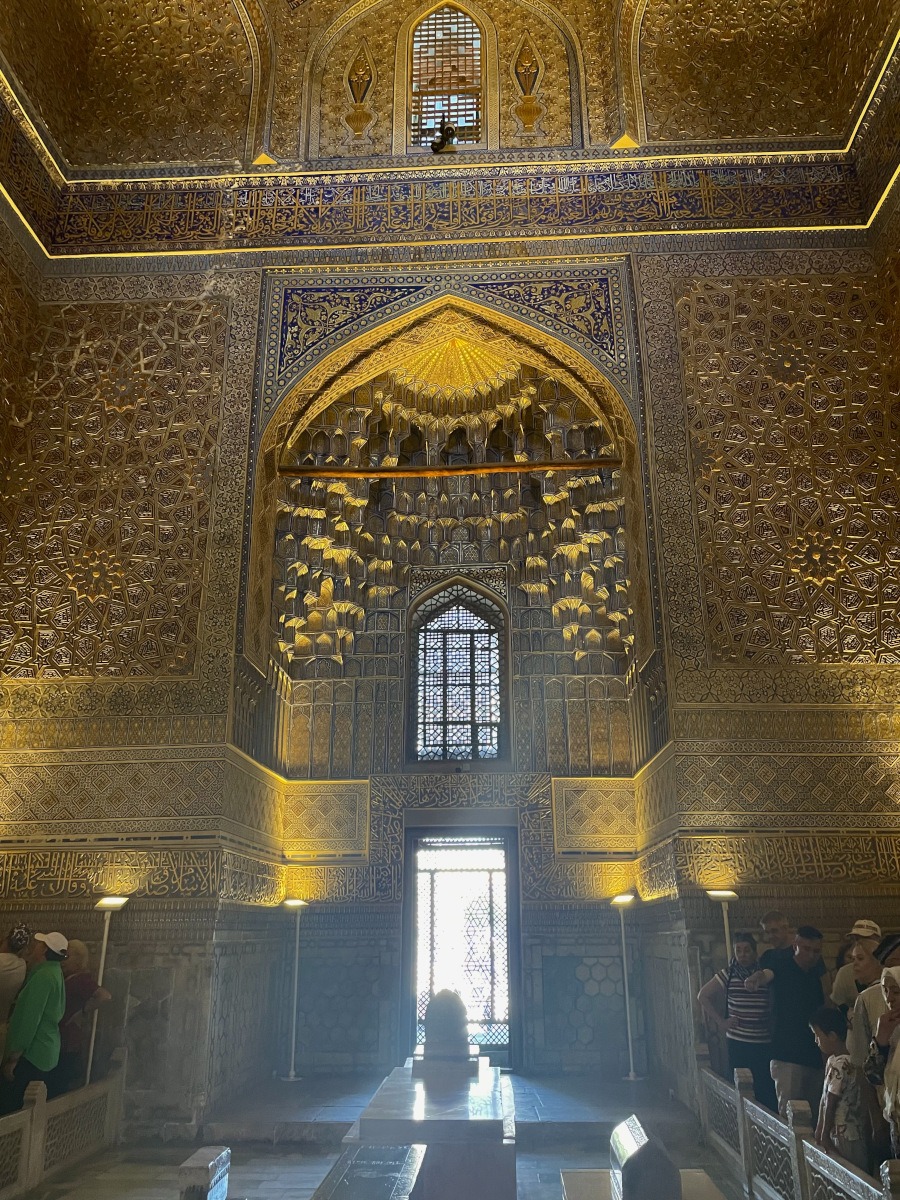
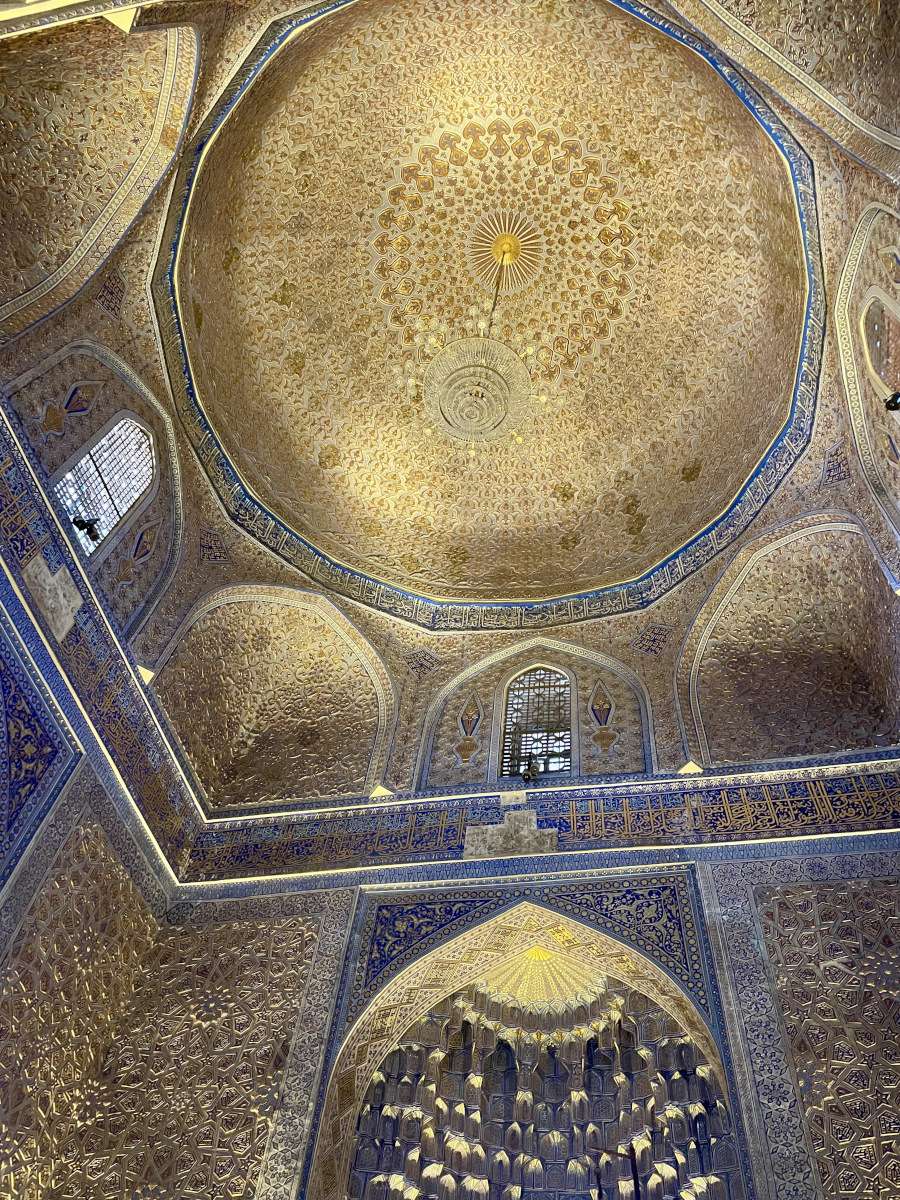
Start with Gur-i-Amir, the tomb of the impavid conquerer and most famous Uzbek historical figure: Amir Timur (Tamerlane). Completed in 1404, it is the perfect introduction to Samarkand dazzling architecture. Originally intended as a khanaka (a place where scholars congregate), it was converted into a mausoleum where Timur’s grandson body could lay to rest. However, it ended up also being Timur’s own tomb after he died in China, as the heavy winter snows made it impossible to bring the body back to his hometown.
The mausoleum has an imposing azure dome at the centre, only overshadowed by a dazzling interior, where gold-plated and onyx-covered walls leave you awe-struck.
In contrast, the nearby Aksaray mausoleum feels much quieter and intimate, while not any less beautiful on the inside.
Insider Tip: Gur-i-amir mausoleum is not very big on the inside and can attract large crowds. If you don’t like elbowing each other for your five-second photo opportunity, come early in the morning!

2. STEP INTO THE REGISTAN – THE BEATING HEART OF SAMARKAND
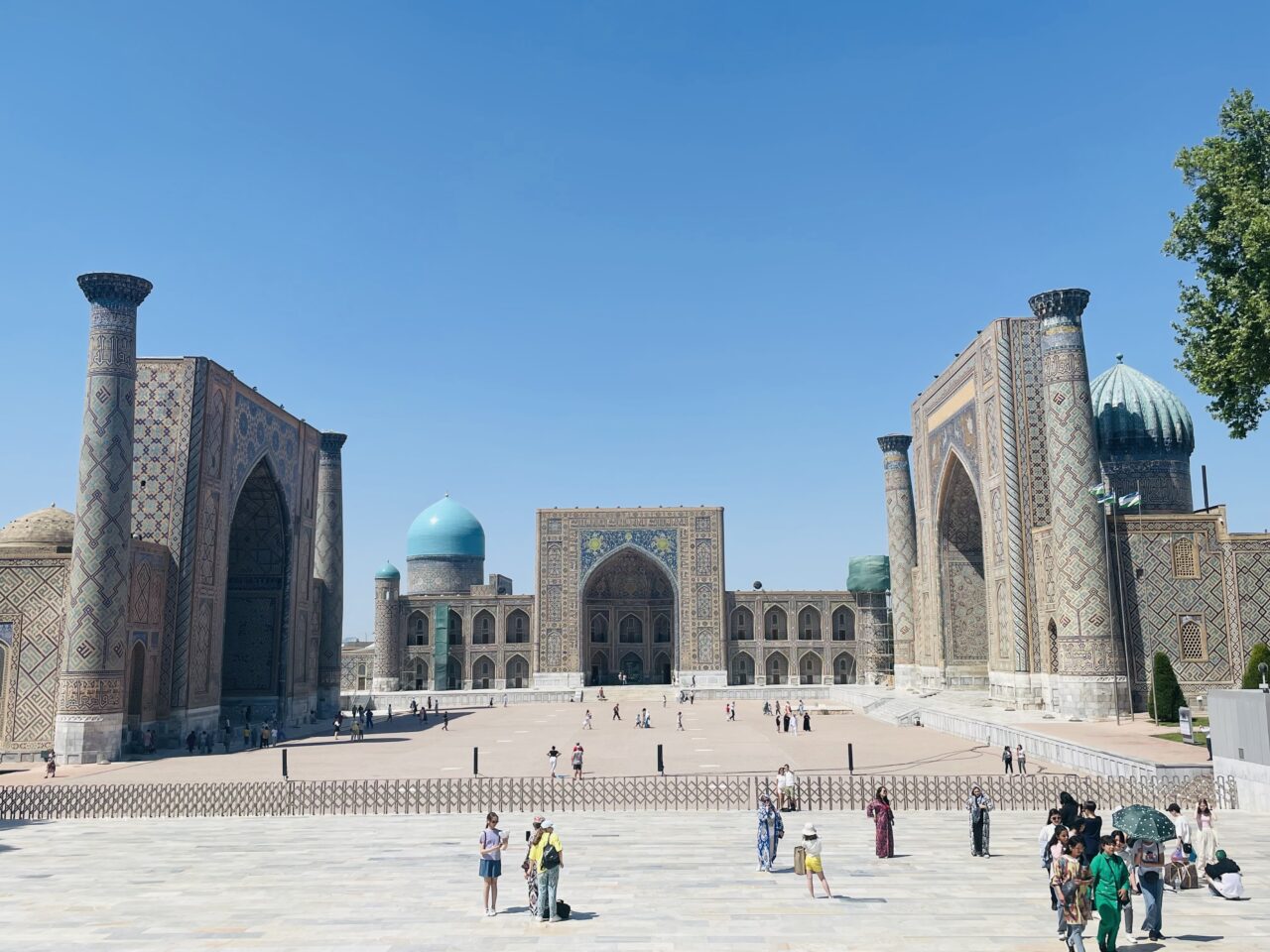
About 5 min walk from Gur-i-Amir, you’ll find what is without a doubt Samarkand’s most iconic landmark: the Registan.
You can take photos from the viewing platform in front of the square, but you’ll need a ticket to enter because the entire complex is fenced off.
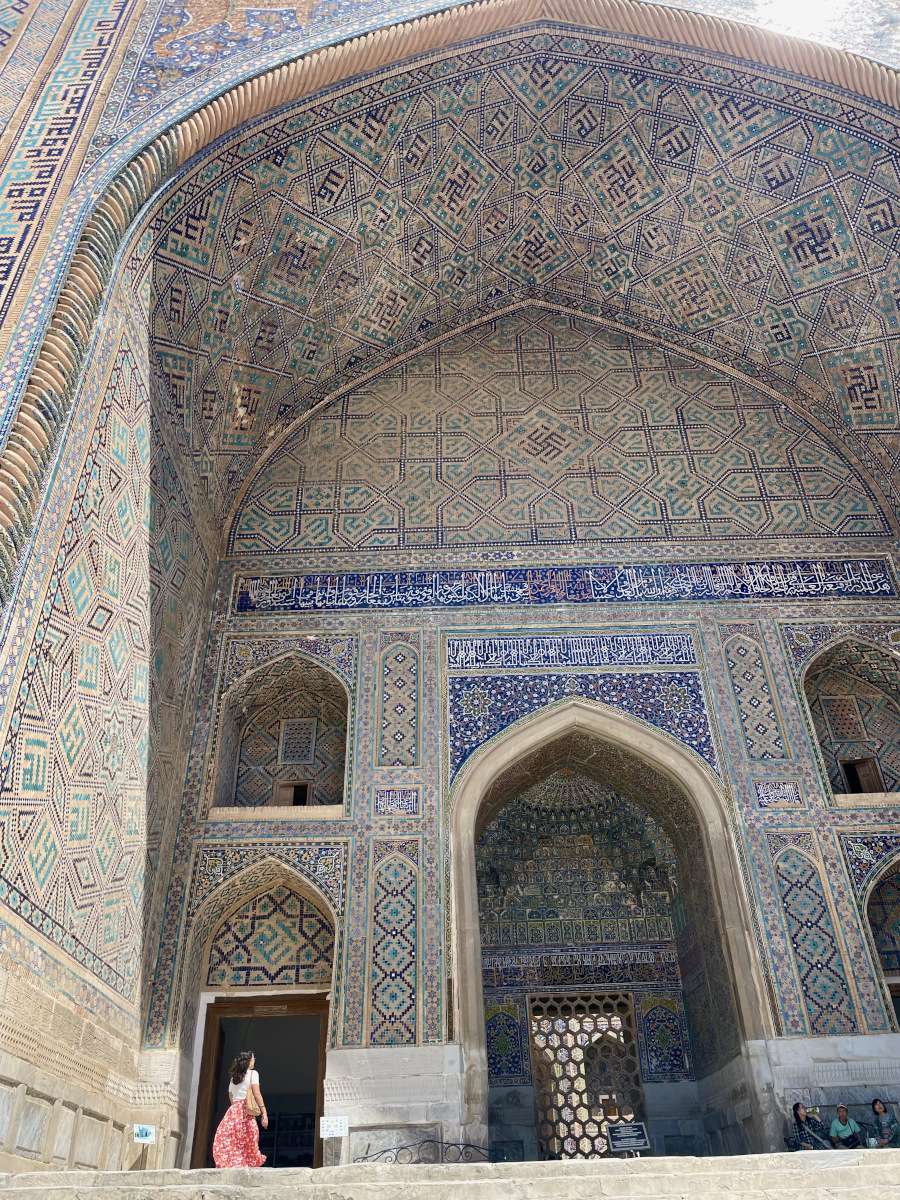
As you get in, the imposing Tilya-Kori stands in front of you, with the Ulugh Beg and Sherdor madrasahs on the left and right hand side respectively.
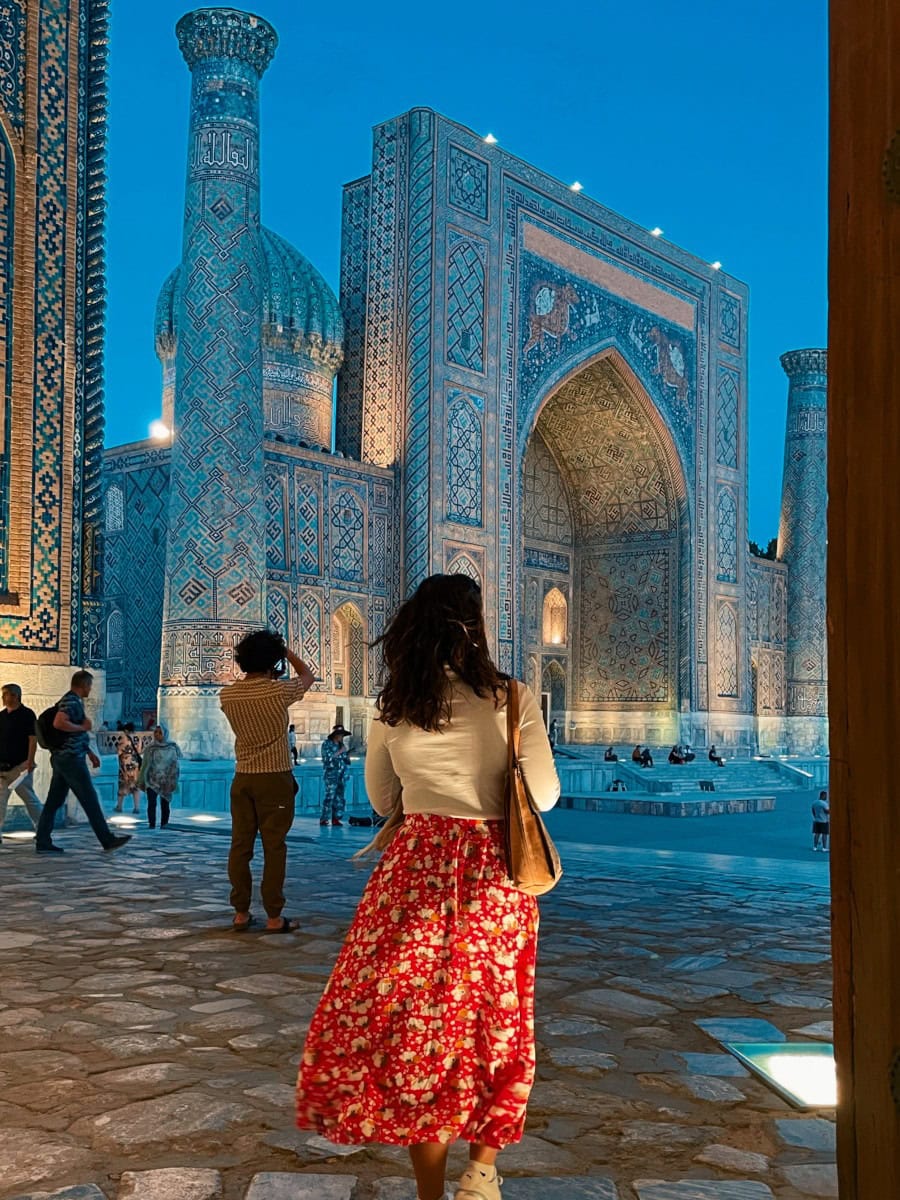
The Ulugh Beg madrasah is the oldest of the three. Built in 1420 by Timur’s grandson Ulugh Beg, it features geometrical motives resembling shining stars, reflecting his interest in mathematics and astronomy. Opposite to it, Sherdor madrasah was only built around 1630 but is not any less beautiful, with its distinct tiger mosaics on the front facade.
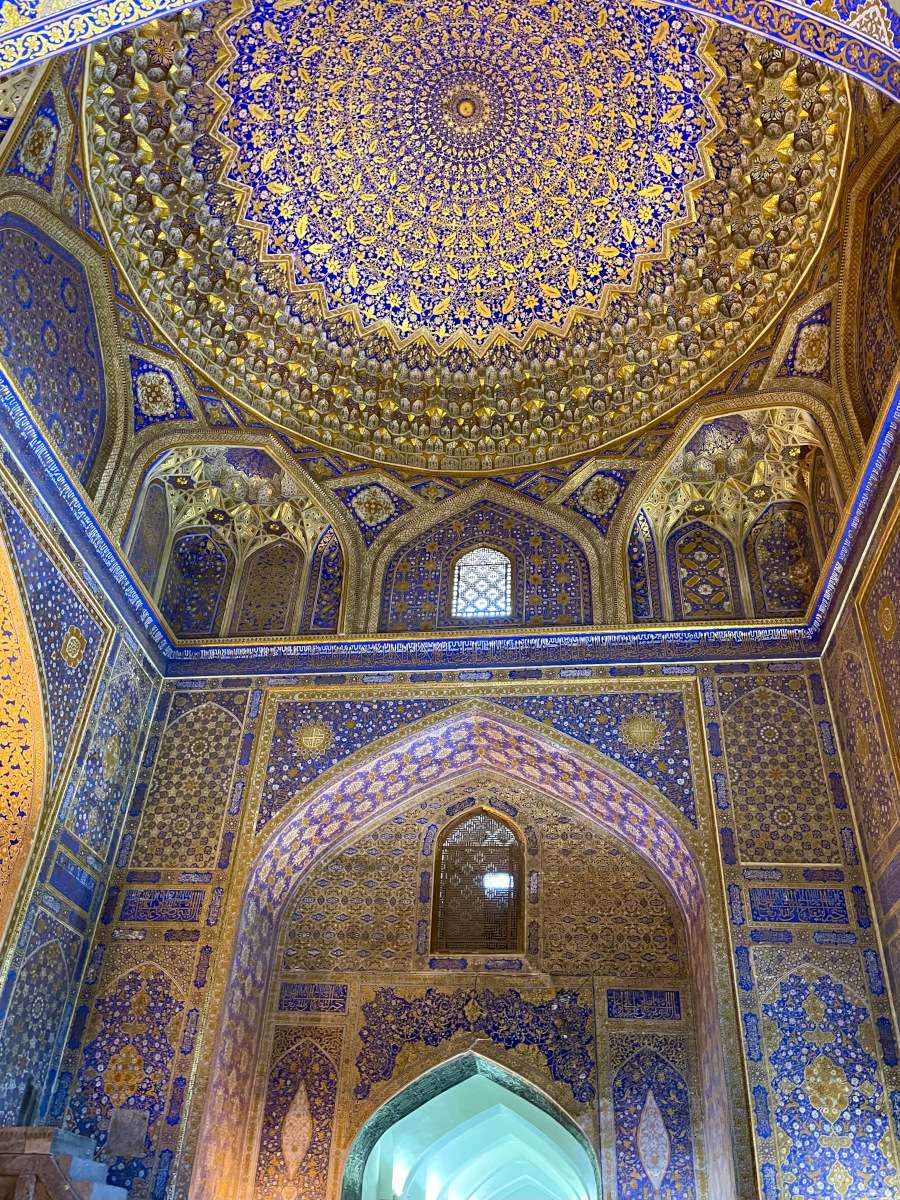
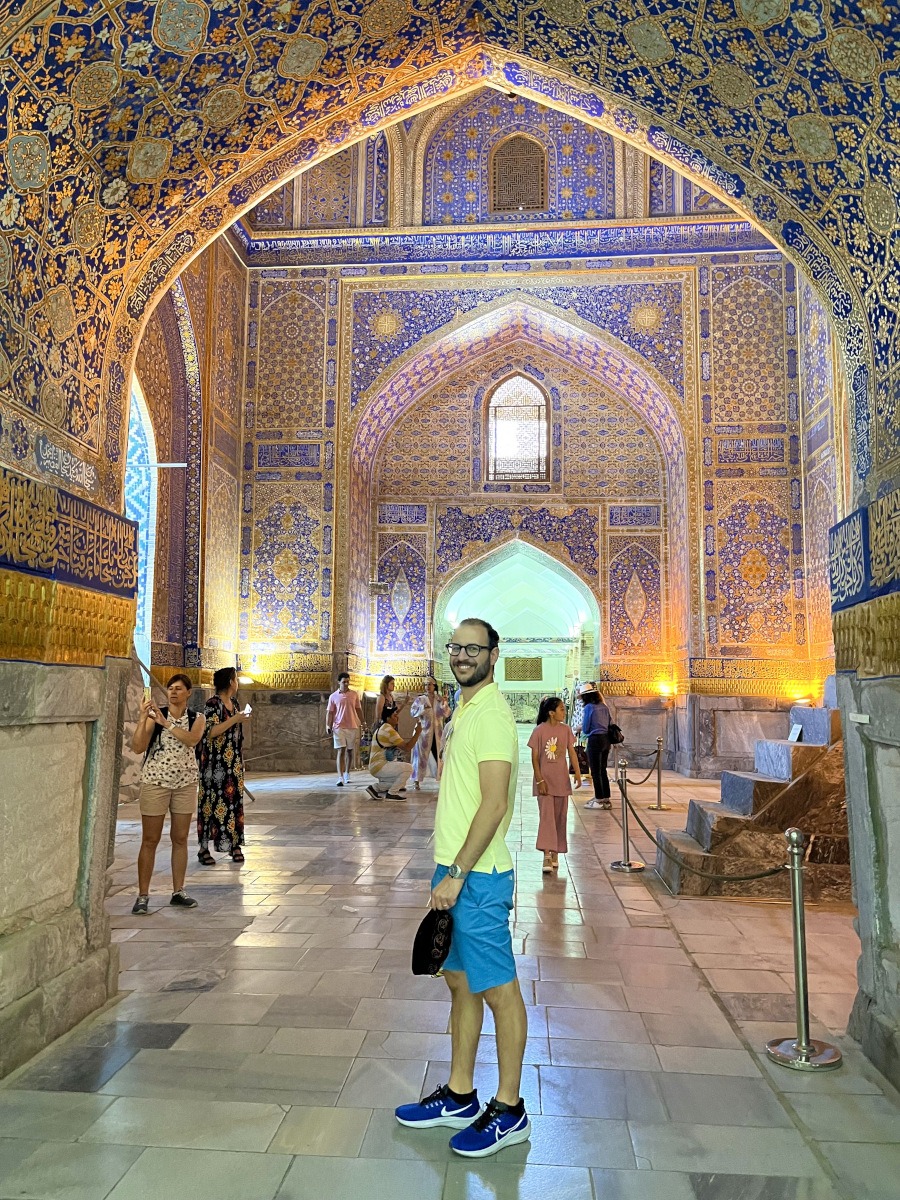
Finally, Tilya-Kori represents the latest addition, completed in 1660. It’s impressive from the outside, but remarkable on the inside. The golden and purple-hued interiors alone are worth the trip, being the most memorable we have seen in Uzbekistan.
The whole complex is so imposing and beautifully decorated that we spent hours simply admiring the architecture and taking photos from multiple angles.
Simply put, the Registan is one of the most spectacular complexes we have ever seen, and you can’t miss it.
3. COME BACK TO THE REGISTAN AT NIGHT
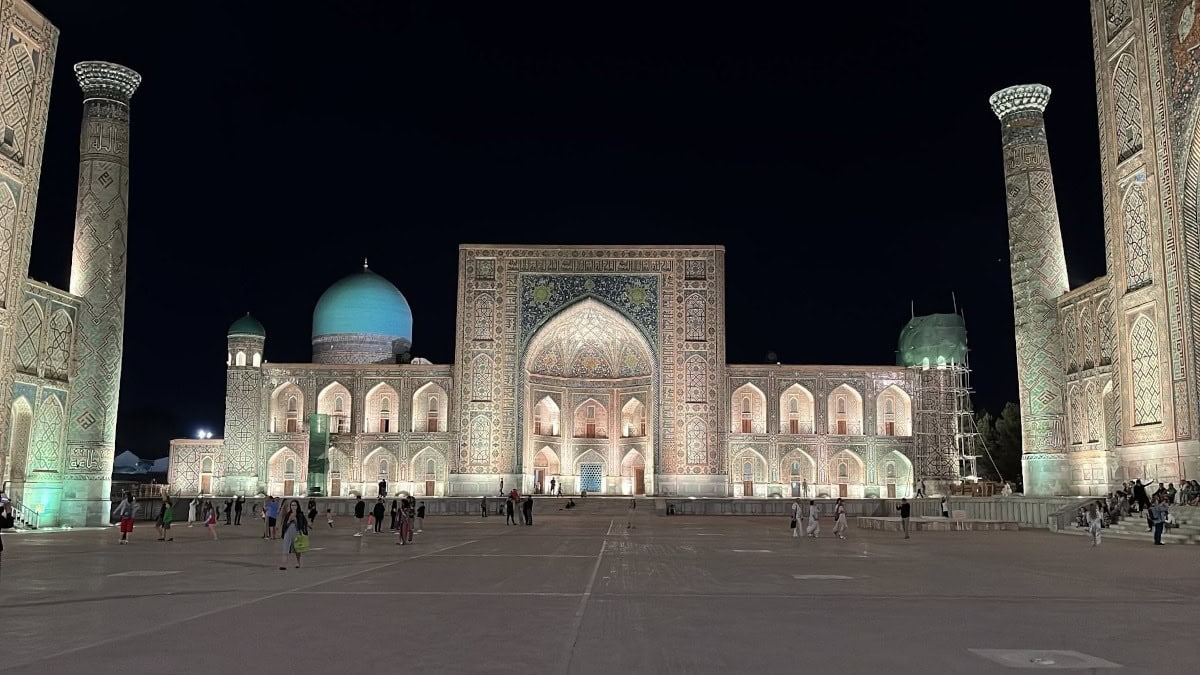
We’re going to be honest here. We loved the Registan so much that we came back multiple times a day.
The ticket only allows a single entry, so we bought a second one to admire the complex up close in the softer light.
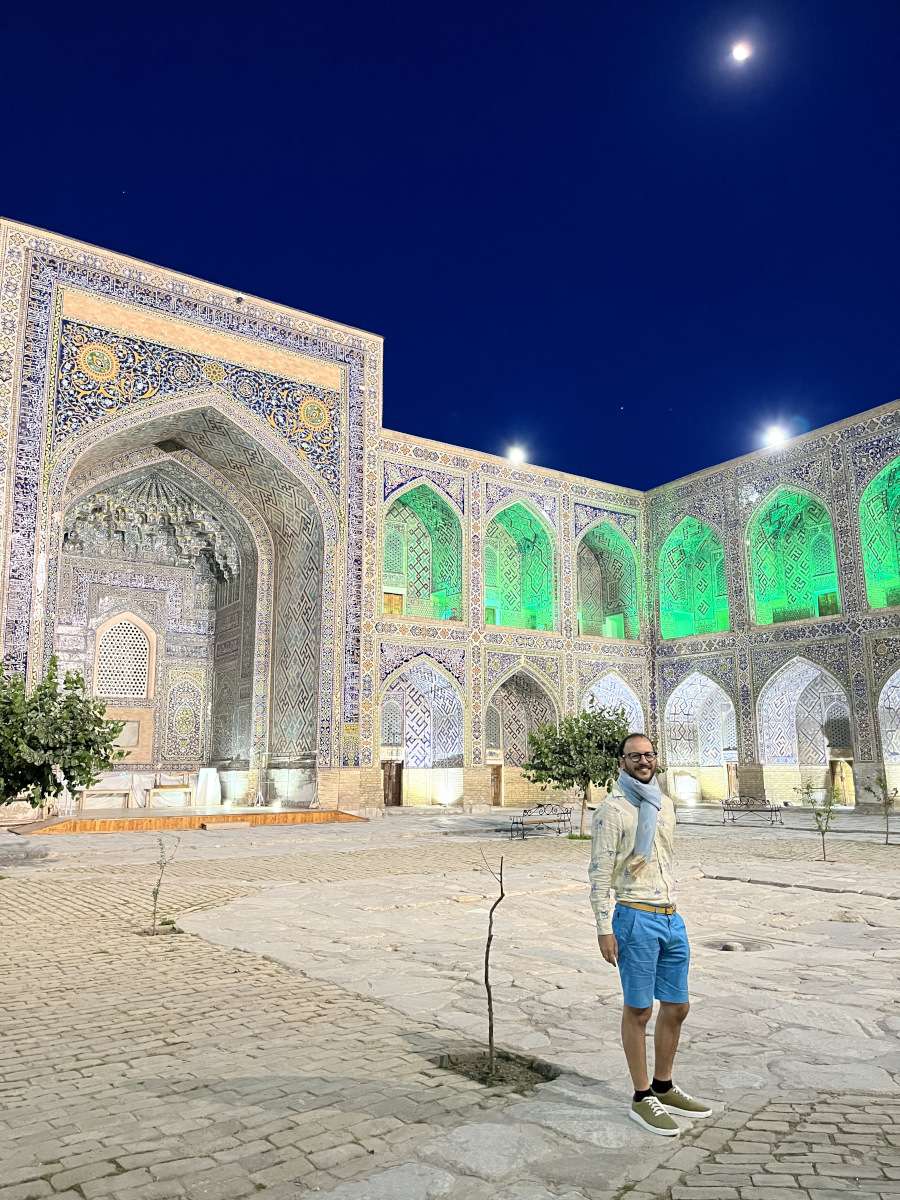
This is when the Registan looks unreal. As the sun sets and the lights begin to illuminate the facades, the whole atmosphere turns magical!
We lingered for a while soaking it all in, before wandering off to eat at a little restaurant nearby. When we returned, the Registan had switched into its 8pm light show and honestly, it wasn’t for us.
The whole thing felt a bit kitsch, almost like watching a UNESCO site get dressed up for a theme park. But everything leading up to that moment, the atmosphere, the architecture, the way the square glows at sunset, was absolutely worth the visit.

4. CHASE SUNSET THROUGH THE TURQUOISE TOMBS OF SHAH-I-ZINDA
Arriving to Samarkand in the late afternoon, there was one place we were really eager to see: the Shah‑i‑Zinda necropolis.
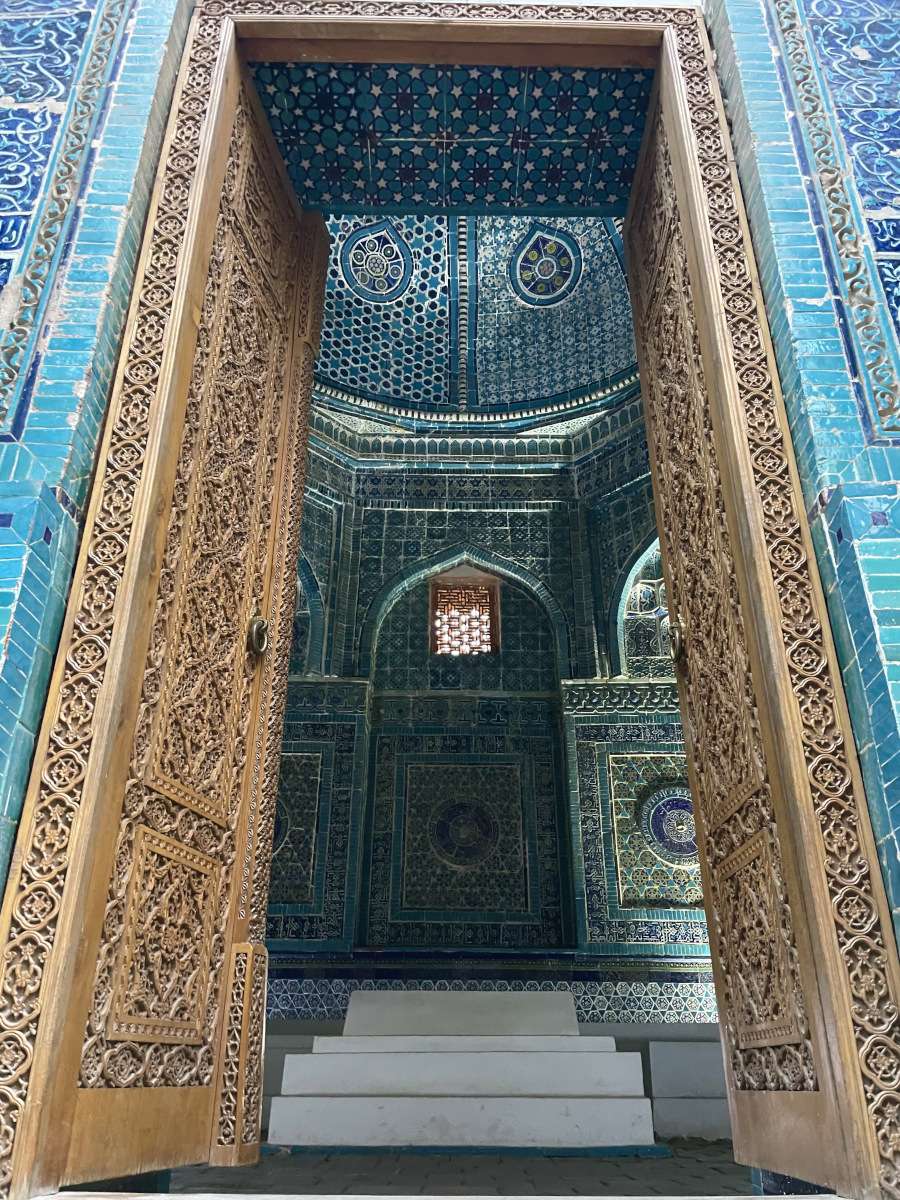
After the Registan, it’s arguably the city’s most iconic sight, and it’s at its most atmospheric in the early morning or at sunset. Climbing the first staircase leads you into a narrow corridor lined with radiant turquoise mausoleums, some from the 11th century. Most are grand and imposing, built for prominent figures and aristocrats, including members of Timur’s own family.
Like many of Samarkand’s monuments, Shah‑i‑Zinda has undergone extensive restoration to revive its original splendour.
We usually gravitate toward places that are rough on the edges, a testament of authenticity and having passed the “baptism of time”. But here the careful restoration felt justified. It honoured the ancient craftsmanship and allowed the complex’s full beauty to shine through.
Shah‑i‑Zinda is still an active pilgrimage site, which gives it a quiet, reverent energy despite its stunning visual impact. This doesn’t stop you from taking plenty of photos, but it’s worth remembering that locals come here to mourn and pray, so a respectful approach goes a long way.
We stayed until closure, watching the sun dip behind the silhouette of the vast Bibi‑Khanym Mosque in the distance.


5. ADMIRE BIBI-KHANYM – THE COLOSSAL QUEEN OF SAMARKAND
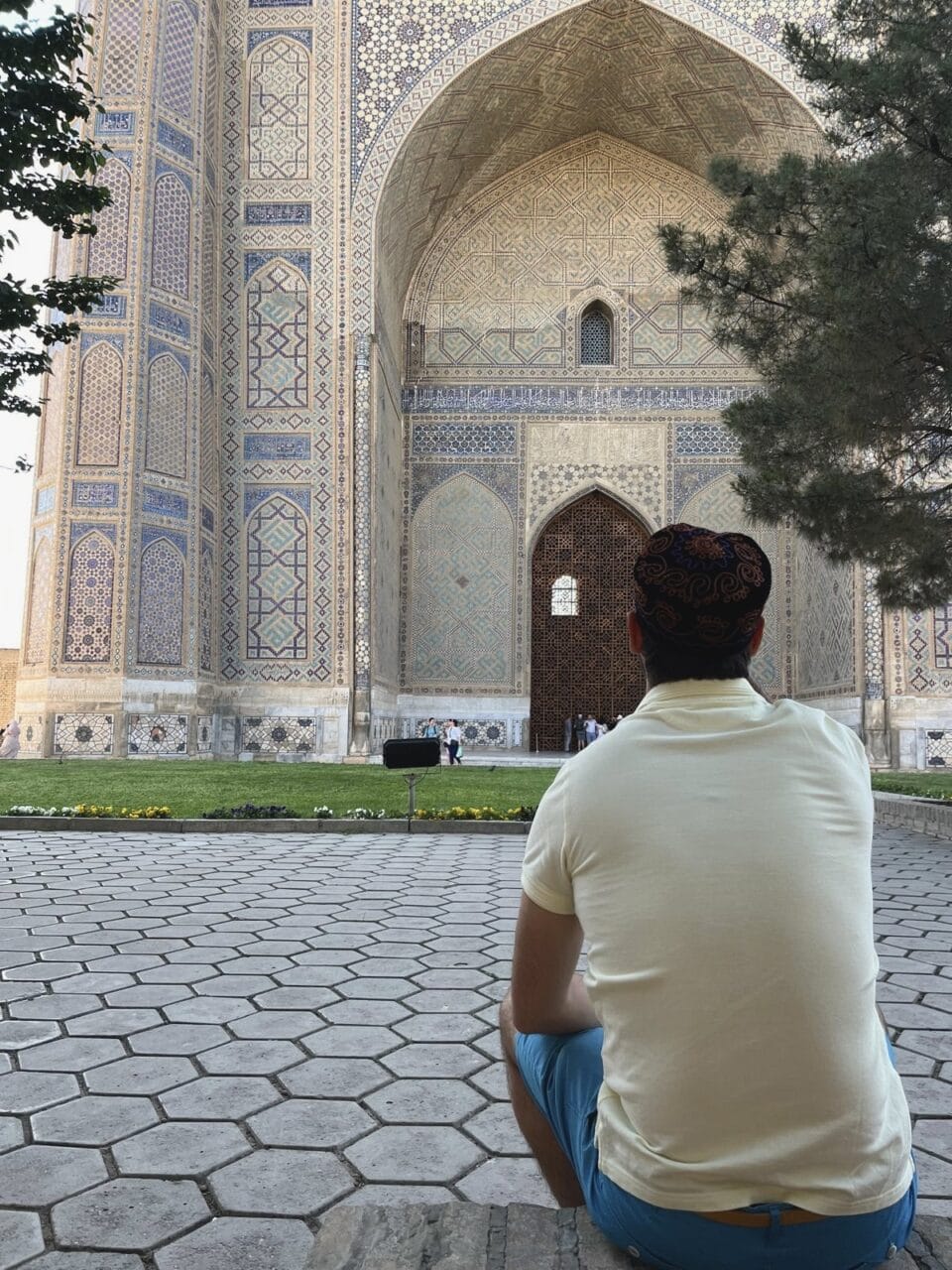
Not far from the Registan rises another of Samarkand’s great showstoppers: the colossal Bibi‑Khanym Mosque.
In an age when we’re used to oversized buildings (religious or not), it’s easy to forget how extraordinary such scale would have been in the 14th century. As we arrived in front of the main gate, we couldn’t comprehend how big the opening arch was!
The mosque was commissioned by Timur’s favourite wife, Bibi‑Khanym, as a tribute while he was away campaigning in India. Naturally, it was meant to be the most magnificent structure ever built.
But its creation wasn’t without drama.
The ambitious design pushed the limits of the era’s engineering, and legend has it that the chief architect fell hopelessly in love with the queen (how cliche). When she urged him to hurry, he supposedly demanded a kiss in exchange (on the cheek apparently). Needless to say that the poor architect was granted an immediate ticket to heaven once Timur found out…
Despite extensive Soviet‑era restoration, the mosque still bears cracks, leaning walls, and crumbling details. These imperfections add character in our opinion. This giant has weathered earthquakes, neglect, centuries of history and an impudent architect.
But it’s still standing with remarkable grace.

6. SHOP IN A LOCAL BAZAAR
A short stroll from Bibi‑Khanym brings you to Siyob Bozori, Samarkand’s main agricultural market.
We always make time for local markets, as we feel they’re such a vivid window into everyday culture. Our favourite one was in Tashkent, but this one was still worth visiting. We spent a while drifting between stalls piled high with fresh produce, nuts, spices, and sweets, soaking in the bustle and getting a small glimpse of daily life in the city.
If you’re on a hunt for antiques, we heard that nearby Choychana Mubarak is a great place to stop by, although we didn’t personally had the pleasure to visit.
7. MAKE A DAY TRIP TO SHAHRISABZ
If you’re in Samarkand for more than 2 days, making a day trip to Shahrisabz is a good option.
We organized this directly through our hotel, but alternatively you can find various tours using Get Your Guide.
Shahrisabz is famous for being the birthplace of Amir Timur. The colossal Ak‑Saray Palace, Timur’s former summer palace now stands in dramatic ruin, with only two giant towering brick pylons remaining. By now, you’ve probably realized that small and quaint, was never really Timur’s style.
As you keep exploring the city, pay also a visit to the Kok‑Gumbaz Mosque (1430) and Dorut‑Tilovat complex (14-15th centuries) with its soft blue domes, and peaceful courtyards where locals linger.
Shahrisabz makes for a pleasant (heat permitting) detour and definitely worth going if you have a day to spare, but we wouldn’t call it an absolute must.
What we really enjoyed was the mountain drive to reach it and the small restaurant at the top of the pass (here), serving unbelievably good kebabs. Honestly, that meal alone justified the excursion.
If you’re heading to Shahrisabz, don’t skip that stop!


8. WALK AROUND SAMARKAND RUSSIAN QUARTER
Focusing only on the headline monuments when you arrive in a new city can feel a bit limiting.
All the major sights above are impressive and absolutely deserve to be at the top of your list. But moving through them the way you’d tick items off a shopping list, you risk missing the richer cultural and historical layers that give a place its soul. The danger is that these landmarks start to feel like isolated tourist attractions rather than living pieces of a city still shaped by the people who call it home.
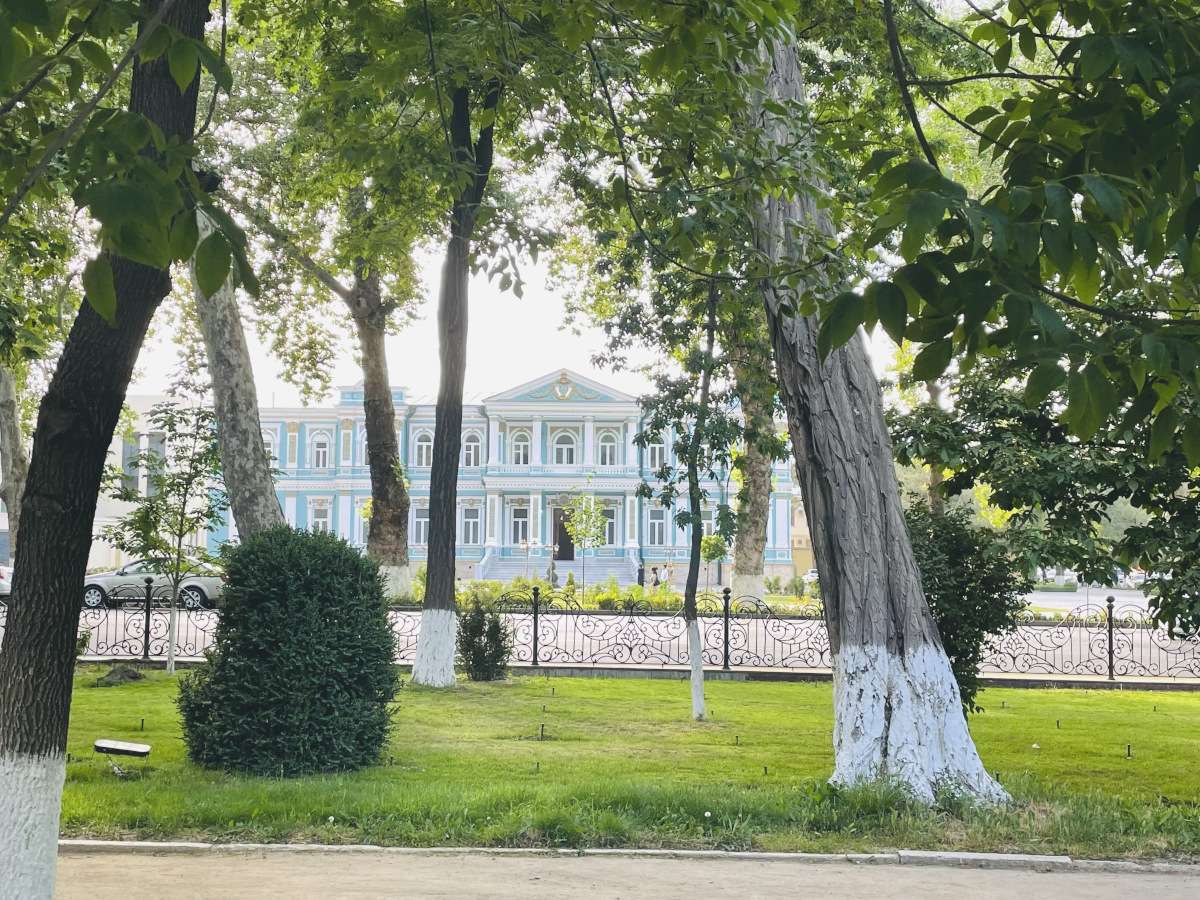
For a glimpse of everyday life removed from Timur’s ancient splendours, head to what locals call “Russian quarter”. This part of Samarkand is distinguished by broad avenues, leafy parks, and elegant European-influenced architecture, in striking contrast with the most well-known monuments.
The area is best explored in late afternoon and evening, when it fully comes to life.
Begin around University Boulevard (or affectionately Bul’var) a leafy walkway flanked by mulberry trees, branching into Alisher Navoi Central Park. The adjacent streets are filled with Tsarist-era buildings, some of them repurposed as cafés, bars, and restaurants. Nestled in what is known as “beer street”, Blues Bar and Green Bear Bar are lively places known for its live music and buzzy atmosphere.
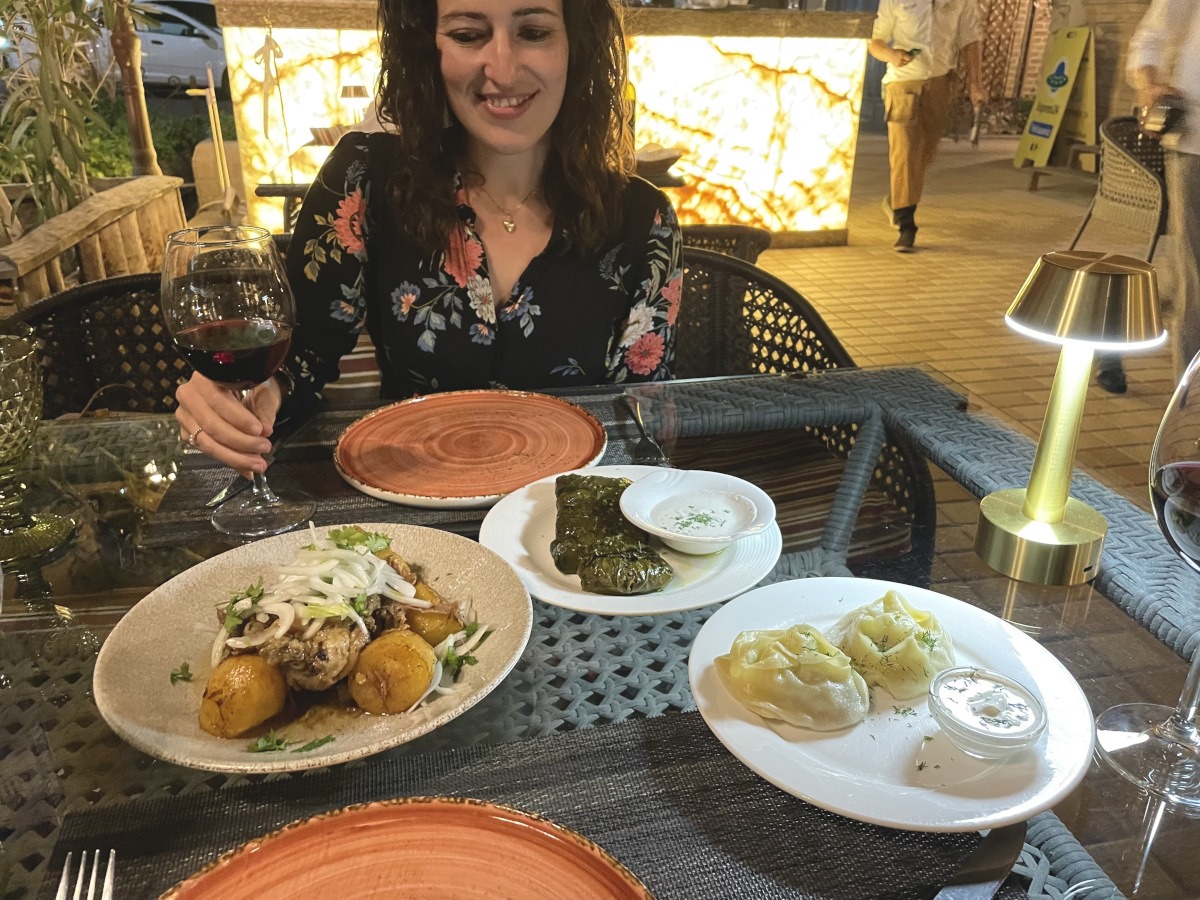
The restaurant at Platan Hotel (where we stayed) is also very good with its mix of traditional and Western-inspired dishes and very well-regarded by locals.
9. LOOK OUT FOR RUSSIAN MOSAICS
On the same Russian Fever vein, take a moment admiring some of the Soviet-inspired mosaics in the city.
Mosaic Wall ‘Girlyanda Vekov’ (‘Garland of the Ages‘) is one particularly worth mentioning. While the wall itself is only from 2009, its kaleidoscopic design is visually impressive.
As a bonus, you don’t really have to go far. It’s just behind the Registan.
10. VISIT ULUG BEG OBSERVATORY
After Amir Timur, Ulug Beg is probably the city’s most notable figure. Far less gifted than Timur in government affairs, his legacy lies in art, maths and most famously, astronomy.
A prominent example is the Ulug Beg Observatory (1429), once one of the finest and largest in the Islamic world.
It sits a bit outside the city, and many travellers only consider it once they’ve run out of major sights.
We didn’t make it there ourselves; three days in Samarkand felt tight, and after the long excursion to Shahrisabz we preferred to slow down rather than rush just to tick another box.
Most travel blogs describe it as an interesting but not essential stop. If you have extra time, it’s certainly worth a look, but don’t go out of your way for it.
11. EXPLORE THE ANCIENT AFRASIYAB SETTLEMENT
A bit like the Ulug Beg Observatory, Afrasiyab is one of those places to visit if you have extra time.
Spread across a vast archaeological area on the northern edge of the city, it preserves what remains of ancient Maracanda, the capital of the Sogdian empire, which thrived more than a thousand years before Timur. The Mongols eventually destroyed it, and today the site is mostly earth mounds and scattered ruins.
Right beside it, sits the Afrasiyab Museum. It hosts 7th century frescoes uncovered during the excavations, depicting royal processions, hunting parties, and diplomatic encounters. Most of them, were exhibited at the Louvre when we were there.
WHERE TO STAY IN SAMARKAND
Hotel Platan – Lovely hotel in the Russian Quarter, including spacious rooms, an idyllic garden and one of the most highly rated restaurants in Samarkand. Not far from the main landmarks and a step away from various bars and restaurants
Kosh Havuz Boutique Hotel – Beautiful modern hotel in prime location, just between Registan and Shah-I-Zinda
L’Argamak Boutique Hotel – Classic uzbek style right in the city centre
Hotel Minor – Unbeatable views of Registan square at very good price
Continental Hotel Samarkand – Large hotel by University Boulevard. Halfway between all the historical landmarks and the more lively Russian Quarter
The Regency – For those who can’t renounce to high-end luxury and don’t mind being far out the city centre
FOOD & DRINKS
Emirhan Restaurant – Part of Emirhan Hotel, this is a prime option for traditional uzbek food combined with a spectacular view of Registan Square (if you sit in the terrace)
Bibi Khanum Teahouse – We ended up here after wandering around far longer than we meant to, only to realise just how hungry we were, and it turned out to be such a good call. The setting feels wonderfully traditional, especially if you settle onto one of the tapchans, those typical raised outdoor sofas. The food hit the spot too, especially shashlik and the classic soups.
Samarkand Osh Markazi – A classic spot for plov, especially at lunchtime when the dish is freshest. It’s lively, local, and unapologetically authentic (the name translates as Plov Centre)
Platan – The restaurant of our hotel is also one of the most popular places in town, and we couldn’t exempt ourselves from trying it. It blends Uzbek classics with some European dishes in a leafy courtyard that feels like an oasis on hot days. Food is great, the setting is elegant, and the vibe is nothing but comforting.
Blues Bar – Quirky spot for some booze and live music for a mix of Central Asian hospitality and Western influence
Green Bear Bar – For “Amir Timur meets Oktoberfest” type of vibe